
Despite 300 years of business history and the best brands today consistently demonstrating that collaboration is the driver of innovation – why do most organisations still struggle to source and keep meaningful, long-term marketing alliances and partnerships? It is tempting to turn to issues regarding technology, markets, mechanics and commercial returns but one of the key hurdles is quite simple and very, very human: Trust is the magical ingredient and if you don’t have it, creative marketing partnership and innovative pioneering with a third-party is impossible.
Continue reading “Trust & Marketing Partnerships: Part One”
Category: Partnerships & Collaboration

Has YouView Got Momentum?
In marketing alliances, Momentum is the engine that drives the initiative and decides whether parties can extract the value they need.
You can never underestimate the power of ‘the Big Mo’. In 2000 Malcolm Gladwell wrote his classic The Tipping Point – spreading the belief that ‘ideas and transformation spread like viruses’. A good alliance, also needs to reach a Tipping Point, with the three elements identified by Gladwell; Contagiousness, Little Causes & Big Effects and – Dramatic Change. In marketing alliances, Momentum is the engine that drives these elements. Without momentum new relationships enter a lethargic spiral and there never is a Tipping Point…
Continue reading “Has YouView Got Momentum?”
Share this now:
A Marketing Partnership Manifesto –
It was great to this week receive a re-posting of my Partnership Marketing Manifesto from the bona fide marketing legend – Gary Hamel. Currently Hamel is Visiting Professor of Strategic and International Management at the London Business School and also the Innovation Architect at the very interesting website – The Management Information eXchange – MIX. Hamel is of course the author behind such seminal texts as ‘Competing For The Future’ , the superb ‘Alliance Advantage’ and a further seven leading books on competitive marketing and innovation. Why did I decide to promote a Partnership Manifesto within MIX?
Continue reading “A Marketing Partnership Manifesto –”
Share this now:
Why You Cannot Go Alone
When faced with lightning fast changes to core technology why try to solve everything yourself? In an uncertain marketing landscape why choose to cross it alone? As Kevin Kelly pointed out in a great piece from mid-2010 the smartest businesses form alliances, build collaborations and use the power of networks to get an advantage.
Continue reading “Why You Cannot Go Alone”
Share this now:
ITV’s Crozier: Collaborative Media Partnerships Are Key
Adam Crozier, the Chief Executive of ITV reveals in an interview in The Guardian that collaborative partnerships will be vital to the future of the broadcaster – and in a multi-channel and ‘non-linear’ world, content owners and distribution channels will have to look at challening new models, including working with brands and organisations traditionally viewed as their media rivals. This reflects the broader trend for collaboration and partnerships to be increasingly seen as the key driver for innovation (see my earlier post on this trend at http://tinyurl.com/6cyhyzp.
Continue reading “ITV’s Crozier: Collaborative Media Partnerships Are Key”
Share this now:
Technology & Innovation – As Adaptation
Kevin Kelly has written a great piece summarising his theory of how technology progresses and changes through an almost Darwinesque like process of evolution – as one piece of innovation leads to another, and another. Unlike biology, in technology this adaptation and change process is measured in months and quarters – rather than millions of years. He points out that great ideas and steps forward build on others – not in isolation. Mozart needed the piano, Van Gough needed the invention of oil based paints. Kelly calls this network of technology and ideas – The Technium.
Continue reading “Technology & Innovation – As Adaptation”
Share this now:
Infographic: Mobile Browsers Compared Worldwide Or What Nokia’s Giving Up
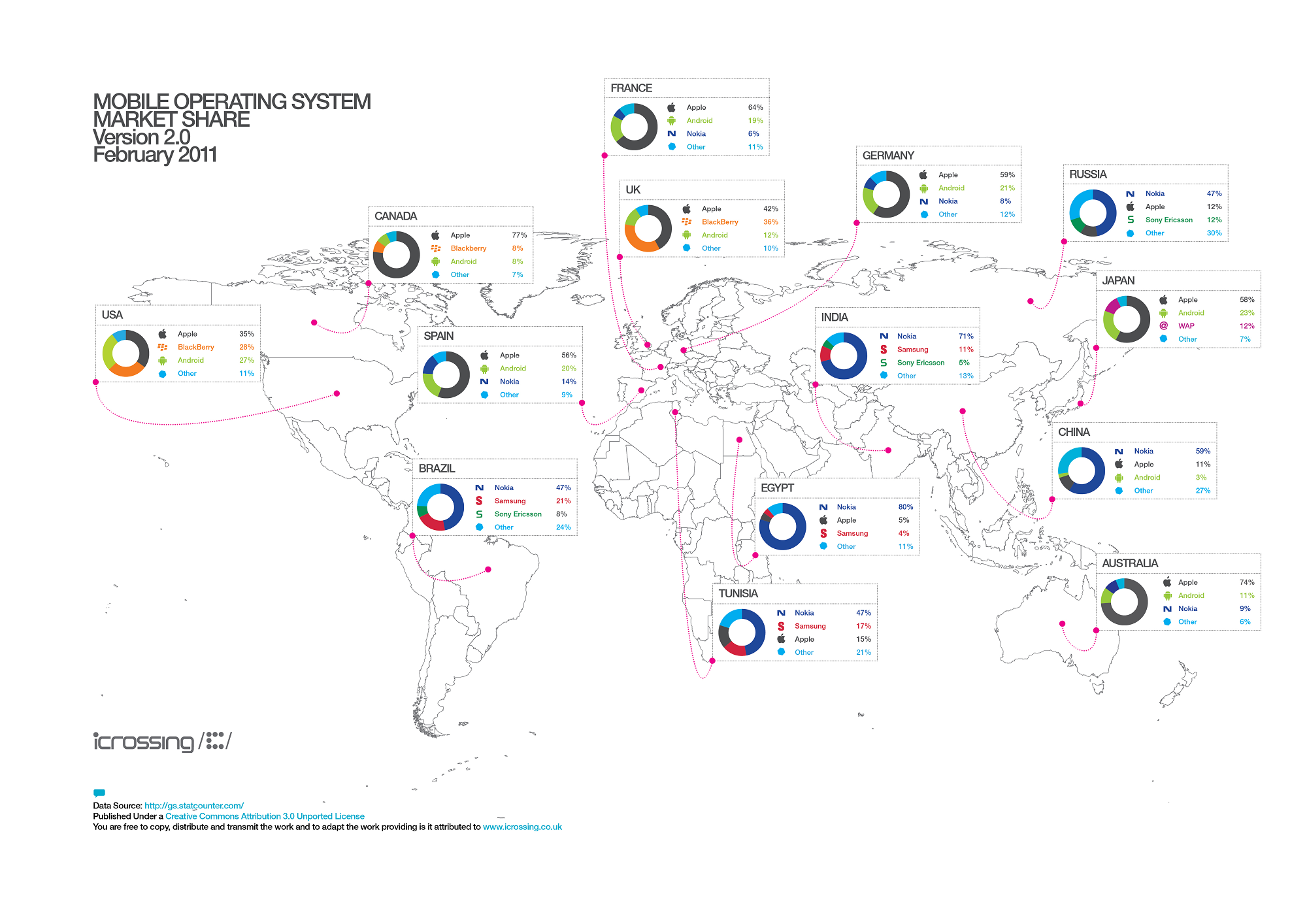
See below for an interesting view of the world – showing how different regions have completely different smart phone markets. Overall of course – Apple is still way out in front but rather than just the usual Apple V Android picture (the latter growing at 800% in the USA) – this Infographic shows how strong Nokia and other platforms are too.
Continue reading “Infographic: Mobile Browsers Compared Worldwide Or What Nokia’s Giving Up”
Share this now:

Nokia’s Real Problem: It Is In The Commodity Trap
This is a very interesting piece by Henry Chesbrough that explains the dilema that technology marketers have created by being caught up in the endless loop of ‘innovation’ – which for many means continuous product development cycles, rather than thinking about their models – leading them to being increasingly commodified. I have always felt that the most interesting aspect of Apple was not the iPod and iPhone themselves (brilliant though they may be) – but the fact they built a vibrant new model for selling music and then apps. My view of course, as shown by the General Electric Innovation report from January this year – is that genuine innovation comes not from internal product refinement, but from collaborating with partners. In the meantime – enjoy this great piece by Chesbrough. via Nokia’s Real Problem: The Commodity Trap [Blog].
Share this now:
Hollywood leads the way on how to create brand partnerships
An interesting piece reminding how the movie industry uses promotional marketing Partnerships to drive massive value and exposure. Many marketers will no doubt consider the unique appeal of entertainment means such partenrships sit more naturally in Hollywood. However – the principles are the same as for any other marketing partnership. What can you build and offer your collaborators and how can you gain leverage for what they can offer you?
For more information, see Benchstone.
via Hollywood lead’s the way on how to create brand partnerships.
Share this now:
What % Should Apple And Google Be Taking?
For anyone intersted in the creation of media content the piece below by James McQuivey of Paid Content makes for some sobering reading. As a colleague told me two years ago technology companies are selling expensive chip driven hardware and network driven data plans -on the back of the appeal that is created by the content created by journalists, musicians and other creators.In the clamour to reach the potential gold of sexy new users the content creators have bent over to supply. It is well known that the biggest winners in the gold rush were Levi jeans, the banks, railroads and shovels: all selling stuff to the gold miners, who thought that their reward would come later.
Continue reading “What % Should Apple And Google Be Taking?”
 Andrew Armour's Benchstone Blog